
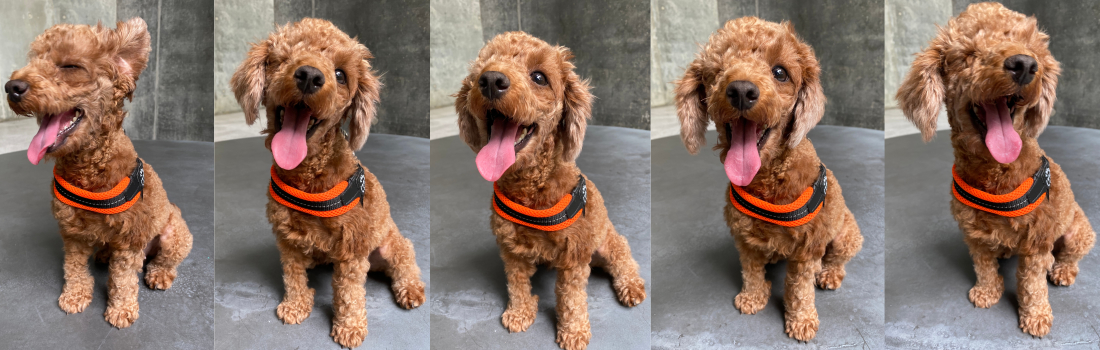
As an introvert, I was bewildered when strangers (i.e. neighbours I’ve never spoken to) started chatting to me. The reason: my newly-adopted, one-eyed rescue dog.
Sadie, who both looks and behaves like a used teddy bear (see picture), trots up to every passerby during our walks, gazing at them with her single, shiny-button eye. More often than not, she is lavishly rewarded with coos and scratches. People want to know about her, how old she is, how she lost her eye. I have never spoken to so many neighbours in my life. There was a little boy who showed particular interest:
Boy: She only has one eye!
Me: Yes.
Boy: (distraught) Will…will it grow back? Me: (taken aback) Umm…No? Boy: (face crumpling) It won’t grow back? Me: (think about lying, decide against it) No…Sorry.Boy: (definitely going to cry) …
I hightailed it out of there.
Looking back, I feel terrible about the way I handled the incident. Yes, I told him the cold, hard truth—eyes don’t grow back, not even for sweet little rescue dogs who’ve had more than their fair share of hardship. Yet, it wasn’t the whole picture. I could have said, no, eyes don’t grow back, but Sadie is doing great. She’s already an expert at cuddling; she greets every meal like it’s Christmas morning; you should see the way she runs—just a blur of tongue and fur; she is happy; she is loved. The loss of her eye didn’t prevent any of this. And I wouldn’t even need to sugar-coat anything, because it’s all true—this is the whole picture.
When I first started taking writing classes in the US years ago, I was determined to tell the truth during workshop, no matter how unpleasant. The sunny, encouraging attitude of my Californian classmates just made me double down on my stance. Positivity is all well and good, I thought, but someone had to tell the truth. How would we improve otherwise? It was on this truth-telling crusade that I told a classmate who had set a story on a farm, her animals were more interesting than her humans.
Ouch.
The statement was true, but it wasn’t the whole picture. What I should have said was this: the animal scenes in her story were charming and engaging. However, since her plot was designed to revolve around the human characters whose scenes were much less developed than the animal ones, the story felt unbalanced. Put this way, I would have opened up a more fruitful discussion about writing. I could have asked, was writing the human scenes the less fun but still important task she had to power through, or did she feel obligated to centre the story on people, even though that wasn’t really the story she wanted to tell? My critique would have been more helpful that way, but in my ignorance I went with the snappy ‘your animals are more interesting than your humans’ quip, which was cutting and did little to illuminate the way to a better manuscript.
Since that workshop, I have critiqued many stories in writing groups and classrooms, often in the company of more generous and experienced fellow writers. I still want to be honest, though I am now more considered in the way I dispense my ‘truth’. Rather than just zoom in on a flaw and flog it to death, I try to understand the writer’s intent for the story, and then identify the elements that are working or not working to achieve that intent.
As I write this, Sadie is curled up at my feet, exhausted after a confrontation with her arch-nemesis (shhh nobody tell her that was her own reflection). Looking down at the pile of brown fluff, I am reminded—don’t just focus on the missing eye, see the whole picture.
Photo credit: Sarah Soh